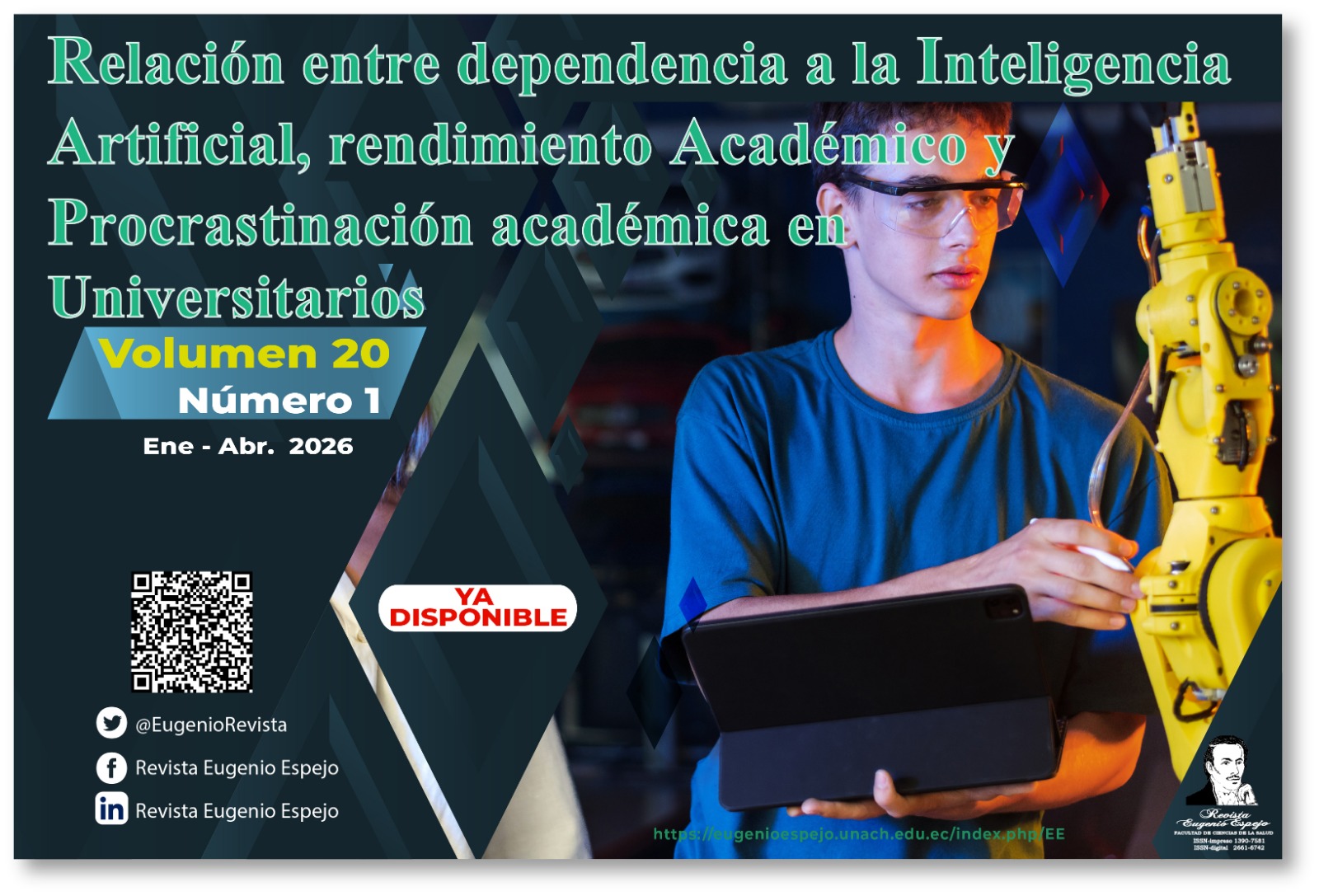
Relationship between dependence on artificial intelligence, academic performance, and academic procrastination in university students
DOI:
https://doi.org/10.37135/ee.04.25.08Keywords:
Artificial Intelligence, Academic Performance, EducationAbstract
This research aimed to determine the relationship between dependence on artificial intelligence, academic performance, and procrastination among university students in the Puno region. A non-experimental, cross-sectional, correlational study was conducted with a sample of 492 university students from different universities, aged 18-35 years. The scales of dependence on artificial intelligence (DAI), university academic performance (RAU), and academic procrastination (EPA) were used as measurement instruments. The results showed that 53% of the participants were male, 92.1% were between 18 and 25 years old, 51.4% came from a national university in Juliaca, enrolled between the first and third cycles (51.8%), with the engineering field standing out with 49.4% participation. Sixty-three point four one percent of participants indicated a greater inclination toward using ChatGPT. The overall values showed a significant inverse correlation (r = -0.122; p = <0.007) between AI dependence and academic performance; there is no significant correlation between AI dependence and academic procrastination (r = 0.022, p = <0.627), demonstrating that university students who do not have high levels of dependence on artificial intelligence maintain adequate academic performance levels and do not tend to procrastinate. A significant inverse relationship was found between AI dependence and the lack of organization of teaching materials (r = -0.225, p = <0.000), suggesting that disorganized study materials can prompt the need to resort to AI as a quick fix.
Downloads
References
Acosta P. El impacto de la inteligencia artificial en la educación superior. Informe del Consejo de Europa - ES de ES: Aprendemos entre todos [Internet]. 2022 [cited 8 Nov 2025]. Available from: https://www.espaciosdeeducacionsuperior.es/07/12/2022/__trashed-2__trashed/
Digital Education Council global AI student survey 2024. Encuesta mundial sobre inteligencia artificial a estudiantes del Consejo de Educación Digital 2024 [Internet]. [cited 5 Mar 2025]. Available from: https://www.digitaleducationcouncil.com/post/digital-education-council-global-ai-student-survey-2024
Tyton Partners. Time for Class 2024: Unlocking access to effective digital teaching and learning [Internet]. 2024 [cited 10 Nov 2024]. Available from: https://4213961.fs1.hubspotusercontent-na1.net/hubfs/4213961/Publications/Time%20for%20Class%202024.pdf
Rojas Marín F de los Á, Espinoza Padilla JG, Mendoza Pacheco MF. Inteligencia Artificial: Dependencia y la Afección del Pensamiento Crítico. Cienc Lat Rev Científica Multidiscip. [Internet]. 2024 [cited 7 Mar 2025]; 8(4):12590–608. Available from: https://ciencialatina.org/index.php/cienciala/article/view/13462
Espinoza Vidaurre SM, Velásquez Rodríguez NC, Gambetta Quelopana RL, Martínez Valdivia AN, Leo Rossi EA, Laura de la Cruz KM, et al. Influencia de la inteligencia artificial en la eficiencia del rendimiento académico: un análisis de determinantes. RISTI - Rev Ibér Sist Tecnol Inf [Internet]. 2024 [cited 9 Mar 2025]; E70:399–418. Available from: https://dialnet.unirioja.es/servlet/articulo?codigo=9886376
Mukhtar M, Firdos SS, Zaka I, Naeem S. Impact of AI dependence on procrastination among university students. Research Journal of Psychology [Internet]. 2025 [cited 4 Oct 2025];3(1):246–57. Available from: https://ctrjournal.com/index.php/19/article/view/62 Int J Educ Innov Res. 2025;3(1):11–22.
Gavilanes Vásquez PG, Adum Ruiz JH, García Ruiz GS, Ruíz Ortega MG. Impacto de la inteligencia artificial en la educación superior: una mirada hacia el futuro. RECIAMUC [Internet]. 2024 [cited 6 Oct 2025];8(2):213–21. Available from: https://www.reciamuc.com/index.php/RECIAMUC/article/view/1371 DOI: http://dx.doi.org/10.26820/reciamuc/8.(2).abril.2024.213-221
Turnitin. Estudio Time for Class: ¿Cuál ha sido el impacto de la IA en el aprendizaje de los estudiantes en la era digital? [Internet]. Turnitin.com. 2024. [cited 13 Mar 2025]. Available from: https://www.turnitin.com/press/turnitin-estudio-time-for-class
Sabzalieva E, Valentini A. ChatGPT e inteligencia artificial en la educación superior: Guía de inicio rápido. [Internet]. París: UNESCO IESALC;2023;1–16. [cited 15 Mar 2025]. Available from: https://unesdoc.unesco.org/ark:/48223/pf0000385146_spa/PDF/385146spa.pdf.multi
Seo K, Tang J, Roll I, Fels S, Yoon D. The impact of artificial intelligence on learner–instructor interaction in online learning. Int J Educ Technol High Educ [Internet]. 2021 [cited 17 Mar 2025];18(1):1–14. Available from: https://link.springer.com/article/10.1186/s41239-021-00292-9 DOI: https://doi.org/10.1186/s41239-021-00292-9
Ahmad SF, Han H, Alam MM, Rehmat MK, Irshad M, Arraño-Muñoz M, et al. Impact of artificial intelligence on human loss in decision-making, laziness and safety in education. Humanit Soc Sci Commun [Internet]. 2023 [cited 19 Mar 2025];10(1):311. Available from: https://www.nature.com/articles/s41599-023-01787-8 DOI:10.1057/s41599 023 01787 8.
Nasir S. Is AI making humans lazy? Here’s what UAE residents say. Khaleej Times [Internet]. 2018 [cited 8 May 2025]; 20. Available from: https://www.khaleejtimes.com/nation/dubai/Is-AI-makinghumans-lazy-Here-what-UAE-residents-say
Del Cisne Loján M, Antonio Romero J, Sancho Aguilera D, Yajaira Romero A. Consecuencias de la Dependencia de la Inteligencia Artificial en Habilidades Críticas y Aprendizaje Autónomo en los Estudiantes. Cienc Lat Rev Científica Multidiscip. [Internet]. 2024 [cited 15 May 2025];8(2):2368–82. Available from: https://ciencialatina.org/index.php/cienciala/article/view/10678 DOI: http://dx.doi.org/10.37811/cl_rcm.v8i2.10678
Longoni C, Cian L. Artificial Intelligence in Utilitarian vs. Hedonic Contexts: The “Word-of-Machine” Effect. J Mark [Internet]. 2022 [cited 19 May 2025];86(1):91–108. Available from: https://journals.sagepub.com/doi/10.1177/0022242920957347
Abbas M, Jam FA, Khan TI. Is it harmful or helpful? Examining the causes and consequences of generative AI usage among university students. Int J Educ Technol High Educ [Internet]. 2024 [cited 9 Jan 2025];21(1). Available from: https://link.springer.com/article/10.1186/s41239-024-00444-7 DOI: https://doi.org/10.1186/s41239-024-00444-7
Malinka K, Peresíni M, Firc A, Hujnák O, Janus F. On the Educational Impact of ChatGPT: Is Artificial Intelligence Ready to Obtain a University Degree? In: Proceedings of the 2023 Conference on Innovation and Technology in Computer Science Education (ITiCSE); 2023 [cited 15 Jan 2025]. p. 47 53. Available from: https://dl.acm.org/doi/abs/10.1145/3587102.3588827 DOI:10.1145/3587102.3588827.
Gocen A, Aydemir F. Artificial Intelligence in Education and Schools. Res Educ Media. [Internet]. 2020 [cited 20 May 2025];12(1):13–21. Available from: https://sciendo.com/2/v2/download/article/10.2478/rem-2020-0003.pdf DOI: http://dx.doi.org/10.2478/rem-2020-0003.
Daha ES, Altelwany AA. Exploring the impact of using - ChatGPT in light of goal orientations and academic self-efficacy. Int J Instr [Internet]. 2025 [cited 25 May 2025];18(2):167–84. Available from: https://e-iji.net/ats/index.php/pub/article/view/730 DOI: http://dx.doi.org/10.29333/iji.2025.18210a.
Ortega Azurduy M, Machaca Mamani J, Daza Morales J. El efecto de la Inteligencia Artificial en el rendimiento académico de estudiantes de ciencias administrativas en la Universidad Católica Boliviana. Rev Educ Super [Internet]. 2023 [cited 1 Jun 2025];10(3):13–22. Available from: http://www.scielo.org.bo/scielo.php?pid=S2518-82832023000300013&script=sci_arttext DOI: https://doi.org/10.53287/mzkv9068uw14f
Hernández-Sampieri R, Mendoza Torres CP. Metodología de la investigación: las rutas cuantitativa, cualitativa y mixta. México: McGraw-Hill Education; 2018.
Hernández-Sampieri R, Fernández Collado C, Baptista Lucio M del P. Metodología de la investigación. 6ª ed. México: McGraw-Hill; 2014.
Carrazco Díaz S. Metodología de la investigación científica. 2ª ed. Lima: Editorial San Marcos; 2019.
Ortega C. ¿Qué es el muestreo por conveniencia? [Internet]. 2024 [cited 22 Nov 2024]. Available from: https://www.questionpro.com/blog/es/muestreo-por-conveniencia/
Morales-García WC, Sairitupa-Sánchez LZ, Morales-García SB, Morales-García M. Development and validation of a scale for dependence on artificial intelligence in university students. Frontiers in Education. [Internet]. 2024 [cited 4 Jun 2025];9:1323898. Available from: https://www.frontiersin.org/journals/education/articles/10.3389/feduc.2024.1323898/full DOI: 10.3389/feduc.2024.1323898.
Preciado-Serrano M de L, Ángel-González M, Colunga-Rodríguez C, Vázquez-Colunga JC, Esparza-Zamora MA, Vázquez-Juárez CL, et al. Construcción y Validación de la Escala RAU de Rendimiento Académico Universitario. Revista Iberoamericana de Diagnóstico y Evaluación – e Avaliação Psicológica. [Internet]. 2021 [cited 6 Jun 2025];3(60):5 14. Available from: https://www.redalyc.org/journal/4596/459669143002/html/.
Remaycuna-Vásquez A, Carrión-Barco G, Espinoza-Porras FR, Maquen Niño GLE. Validez y confiabilidad de la escala de rendimiento académico desde la percepción del alumno. Revista de Ciencias Sociales (Ve). [Internet]. 2023 [cited 10 Jun 2025];29(Especial 7):197 209. Available from: https://dialnet.unirioja.es/servlet/articulo?codigo=9034432 DOI: 10.31876/rcs.v29i.40458.
Busko DA. Causes and consequences of perfectionism and procrastination: A structural equation model. [Internet Thesis]. Guelph (ON): University of Guelph; 1998. [cited 12 Jun 2025]. Available from:https://atrium.lib.uoguelph.ca/items/e42af446-ed92-44b7-9ebe-d842068fe363
Domínguez Lara S, Villegas García G, Centeno Leyva S. Procrastinación académica: validación de una escala en una muestra de estudiantes de una universidad privada. Liberabit [Internet]. 2014 [cited 12 Jun 2025];20(2):293–304. Available from: http://www.scielo.org.pe/pdf/liber/v20n2/a10v20n2
Colegio de Psicólogos del Perú. Código de ética profesional. Lima: Colegio de Psicólogos del Perú; 2017.
Universidad Peruana Unión. Código de ética para la investigación (CoEIn). Lima: UPeU; 2016.
Avendaño Porras VC. La adicción a la inteligencia artificial: evaluación de prevalencia y factores de riesgo en estudiantes de posgrado. Rev Enfoques [Internet]. 2024 Jun 30 [cited 16 Apr 2025];5:66–88. Available from: https://revistasdigitales.uniboyaca.edu.co/index.php/EFQ/article/view/1405
Steel P. The nature of procrastination: a meta-analytic and theoretical review of quintessential self-regulatory failure. Psychological Bulletin, 2025 [cited 13 Apr 2025];133(1), 65–94. Available from: https://psycnet.apa.org/buy/2006-23058-004 DOI: https://doi.org/10.1037/0033-2909.133.1.65.
Zumárraga-Espinosa M, Cevallos-Pozo G. Autoeficacia, procrastinación y rendimiento académico en estudiantes universitarios de Ecuador. Alteridad [Internet]. 2022 [cited 18 Apr 2025];17(2):277–90. Available from: https://revistas.ups.edu.ec/index.php/alteridad/article/view/5516
Kim KR, Seo EH. The relationship between procrastination and academic performance: a meta-analysis. Pers Individ Dif [Internet]. 2015 [cited 19 Apr 2025];82:26–33. Available from: https://www.sciencedirect.com/science/article/abs/pii/S0191886915001610 DOI: https://doi.org/10.1016/j.paid.2015.02.038
Rodríguez A, Clariana M. Procrastinación en Estudiantes Universitarios: Su Relación con la Edad y el Curso Académico. Rev Colomb Psicol. [Internet]. 2017 [cited 20 Apr 2025];26(1):45–60. Available from: http://www.scielo.org.co/pdf/rcps/v26n1/0121-5469-rcps-26-01-00045.pdf
Honicke T, Broadbent J. The influence of academic self-efficacy on academic performance: a systematic review. Educ Res Rev [Internet]. 2016 [cited 21 Apr 2025];17:63–84. Available from: https://www.sciencedirect.com/science/article/abs/pii/S1747938X15000639 DOI: https://doi.org/10.1016/j.edurev.2015.11.002
Cosme Garate GA, Cornejo Zúñiga AG, Chumacero Acosta JS, Ruiz Rios A, Tuesta Casique A, Alvarez Arista Y. Enseñanza universitaria y recursos didácticos en el nivel de rendimiento de los estudiantes de pregrado. Rev Científica Episteme y Tekne. [Internet]. 2022 [cited 23 Apr 2025];1(2):e380. Available from: https://revistas.unsm.edu.pe/index.php/rceyt/article/view/380 DOI: 10.51252/rceyt.v1i2.380
Zhang S, Zhao X, Zhou T, Kim JH. Do you have AI dependency? The roles of academic self-efficacy, academic stress, and performance expectations on problematic AI usage behavior. Int J Educ Technol High Educ. [Internet]. 2024 [cited 29 Apr 2025];21(1):1-15. Available from: http://dx.doi.org/10.1186/s41239-024-00467-0
Granda Aguilera DR, Lema Mullo L, Gallegos Gallegos AR. La dependencia de la inteligencia artificial en los estudiantes de bachillerato: implicaciones y recomendaciones para un aprendizaje equilibrado. Polo del Conoc. [Internet]. 2024 [cited 20 may 2025];9(7):2109–30. Available from: https://polodelconocimiento.com/ojs/index.php/es/article/view/7618/html?utm_source=chatgpt.com.
Downloads
Published
Issue
Section
License
Copyright (c) 2026 Revista Eugenio Espejo

This work is licensed under a Creative Commons Attribution-NonCommercial-NoDerivatives 4.0 International License.